English

What are the advantages of using mica sheets over other insulating materials? For engineers and procurement specialists scouring Google for the perfect thermal and electrical barrier, this question is central to countless projects. The answer lies in mica's unique natural properties, offering a combination of high-temperature resistance, dielectric strength, and mechanical stability that synthetic alternatives struggle to match consistently. From aerospace components to industrial furnaces, specifying the right insulator impacts safety, efficiency, and cost. This guide breaks down the key advantages, providing a clear, actionable comparison for your next sourcing decision.
Imagine a production line where heating elements in an industrial oven frequently fail. The culprit? An insulating material that degrades, cracks, or loses its integrity under continuous thermal cycling. This leads to unexpected downtime, costly replacements, and safety risks. Mica sheets provide a robust solution. Their innate structure allows them to withstand temperatures up to 1000°C without melting, burning, or significant thermal expansion. This translates to longer component life, reduced maintenance, and consistent performance. For procurement, it means fewer emergency orders and more predictable budgeting.

Key parameters for high-temperature applications include:
| Parameter | Typical Value for Mica | Importance for Procurement |
|---|---|---|
| Continuous Operating Temperature | Up to 1000°C | Ensures suitability for target application. |
| Thermal Conductivity | Low (approx. 0.71 W/m·K) | Indicates effective insulation, improving energy efficiency. |
| Thermal Shock Resistance | Excellent | Reduces failure risk from rapid temperature changes. |
A motor or transformer malfunction due to electrical breakdown can halt an entire facility. The insulation between conductive parts is the last line of defense. Mica sheets offer exceptional dielectric strength, often exceeding 40 kV/mm. This high dielectric strength, combined with low power loss (high power factor), makes mica an ideal barrier in high-voltage applications. It resists tracking and corona discharge, ensuring long-term electrical integrity. Sourcing high-grade mica means investing in system reliability and protecting expensive equipment from catastrophic failure.
Critical electrical properties to specify:
| Parameter | Typical Value for Mica | Importance for Procurement |
|---|---|---|
| Dielectric Strength | 40-200 kV/mm | Core spec for preventing electrical arcing. |
| Volume Resistivity | >10^15 Ω·cm | Ensures minimal leakage current. |
| Dielectric Constant | 5.4 - 8.7 | Affects capacitance in electronic applications. |
Many insulating materials weaken when exposed to oils, solvents, moisture, or vibration. This is a critical concern in automotive, chemical processing, and marine applications. Mica is inert to most oils, acids, and solvents, and it exhibits excellent resistance to weathering and moisture absorption. Furthermore, it can be fabricated into rigid sheets or flexible composites that maintain their form and function under mechanical stress. This durability simplifies design and extends service intervals. What are the advantages of using mica sheets over other insulating materials? In harsh environments, it's their unwavering stability that sets them apart, a key factor for procurement professionals valuing total cost of ownership over initial price.
Stability parameters to evaluate:
| Parameter | Typical Value/Property for Mica | Importance for Procurement |
|---|---|---|
| Chemical Resistance | Excellent (inert to most acids, oils, solvents) | Ensures performance in contaminated or aggressive environments. |
| Moisture Absorption | Very Low (< 1%) | Prevents degradation and maintains electrical properties in humid conditions. |
| Compressive Strength | High | Withstands mounting pressures and mechanical loads. |
Procurement decisions require clear comparisons. Let's contrast mica with other frequently considered materials. Ceramic fiber boards offer high-temperature resistance but are brittle and have lower dielectric strength. Silicone rubber sheets are flexible but have a much lower temperature ceiling. PTFE (Teflon) has good chemical resistance but can cold-flow under pressure and has thermal limitations. Mica sheets uniquely bridge these gaps, offering a balanced portfolio of thermal, electrical, and mechanical properties. This makes them a versatile, high-performance choice across diverse industries, often negating the need for multiple specialized materials.
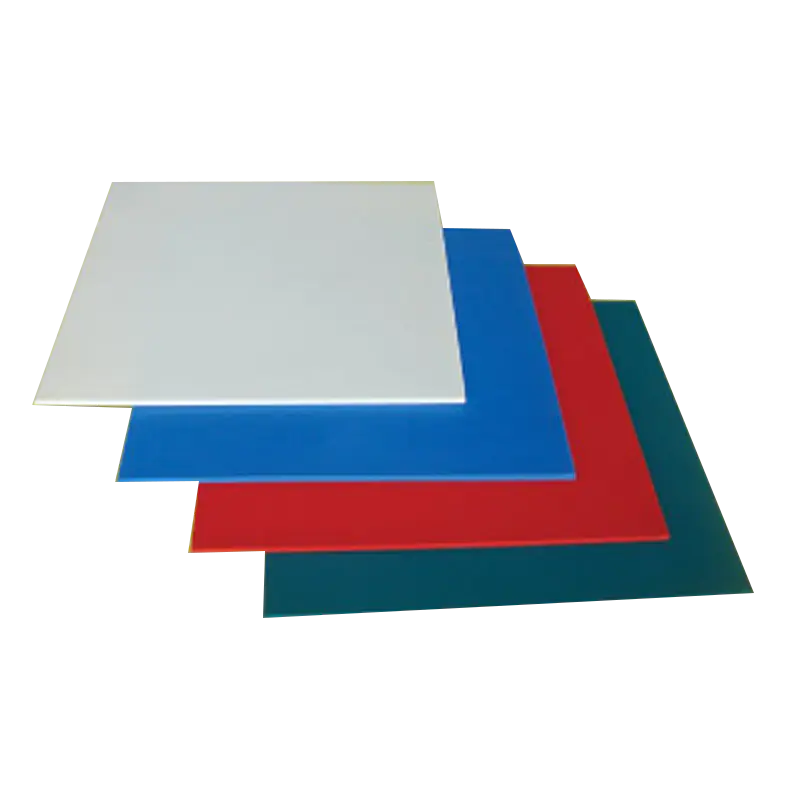
Not all mica sheets are identical. Performance depends on the type (muscovite vs. phlogopite), bonding agent, and manufacturing process. Muscovite mica offers higher dielectric strength and temperature resistance, while phlogopite provides better flexibility and heat stability at slightly lower temperatures. The backing material (silicone resin, epoxy, glass cloth) further tailors properties for specific uses like gaskets, washers, or heater plates. A precise specification ensures the material delivers on its promise in your application.
Procurement specification checklist:
| Specification Item | Options & Considerations |
|---|---|
| Mica Type | Muscovite (higher temp/electrical), Phlogopite (more flexible). |
| Binder/Reinforcement | Silicone resin (flexible, high temp), Epoxy (rigid), Glass cloth backing (added strength). |
| Thickness & Tolerance | Standard range 0.1mm to 3mm. Tight tolerances critical for precise assemblies. |
| Cutting & Fabrication | Die-cutting, punching, or CNC machining available for complex shapes. |
Theoretical advantages only materialize with consistent, high-quality supply. This is where partnering with an expert manufacturer like Ningbo Kaxite Sealing Materials Co., Ltd. becomes crucial. They don't just sell mica sheets; they provide material solutions. Their expertise ensures you get the correct grade and formulation for your specific thermal, electrical, and environmental challenges. With rigorous quality control, reliable lead times, and technical support, they help procurement teams mitigate risk, avoid costly specification errors, and secure a stable supply chain for critical components.
Q: What are the main advantages of using mica sheets over plastic films like PET or PI for insulation?
A: While films like PET (Polyester) or PI (Polyimide, Kapton) are useful, mica sheets offer superior continuous high-temperature resistance (up to 1000°C vs. typically 180-400°C for plastics), far higher dielectric strength, and exceptional resistance to fire, flame, and tracking. Mica is also more dimensionally stable under heat and does not melt or drip.
Q: What are the advantages of using mica sheets over ceramic plates in heating applications?
A: Ceramic plates are brittle and can crack under thermal shock or mechanical vibration. Mica sheets, especially flexible grades, are more resilient to shock and vibration. They are also easier to fabricate into complex shapes, can be made thinner while maintaining strength, and often provide better electrical insulation at high temperatures, making them ideal for embedded heating elements.
We hope this guide has illuminated the key advantages of mica sheets for your projects. Have specific application challenges or parameters you need to meet? Reach out to discuss how the right insulating material can solve your problem.
For reliable, high-performance mica insulating solutions, consider Ningbo Kaxite Sealing Materials Co., Ltd. With extensive experience in manufacturing and supplying quality mica products, we help engineers and procurement specialists solve complex insulation challenges. Visit our website at https://www.kxtsealing.net to explore our range or contact our team directly via email at [email protected] for technical specifications and quotes.
Barringer, J.H., & Jolly, W.P. (1965). The Dielectric Properties of Mica at High Temperatures. Proceedings of the IEE - Part C: Monographs, 112(5), 891-898.
Vaughan, A.S., & Stevens, G.C. (1995). Mica-based insulation for high temperature applications: a review. IEEE Transactions on Dielectrics and Electrical Insulation, 2(5), 789-802.
Chen, G., & Tham, C.H. (2009). Electrical conduction and breakdown mechanisms in mica under high field stress. Journal of Physics D: Applied Physics, 42(6), 065304.
Maiti, S., & Sinha, P.K. (2012). Thermal and mechanical characterization of muscovite and phlogopite mica sheets for aerospace applications. Materials Science and Engineering: A, 550, 168-175.
O’Brien, E.P., & White, S.I. (2003). The effect of moisture on the dielectric properties of mica composites. Polymer Degradation and Stability, 82(2), 255-261.
Kim, J., Lee, S., & Park, J. (2017). A comparative study on the thermal stability of polymer-based and mica-based insulating materials. Thermochimica Acta, 655, 178-185.
Zhang, L., Wang, Y., & Li, H. (2015). Enhancement of thermal conductivity of mica composite for electronic insulation. Composites Part B: Engineering, 78, 42-48.
Patel, M., & Chauhan, K. (2010). Mica as a reinforcing filler in high temperature resistant composites: A review. Journal of Reinforced Plastics and Composites, 29(19), 2919-2937.
Roberts, S.T., & Evans, D.A. (2001). The mechanical properties of natural mica platelets. Philosophical Magazine A, 81(4), 1085-1104.
Fothergill, J.C. (2007). Ageing, space charge and breakdown in mica and related insulators. IEEE Transactions on Dielectrics and Electrical Insulation, 14(4), 898-905.


